
 简体中文
简体中文Search for More Information


Dongguan Jiayi Intelligent Equipment Co., Ltd. was founded in 2009, specializing in the R&D, production and sales of linear motion system solutions.
The company has deeply rooted itself in automation industries including lithium batteries, photovoltaics, energy storage equipment, semiconductor equipment, 3C electronics, solar equipment, medical devices and automotive electronics. We provide automation equipment manufacturers with high-quality, low-cost and short-lead-time automation components.

A timing belt linear actuator is a linear motion device integrated with linear guides, where the timing belt is connected to the motor via extruded aluminum profiles. It realizes high-speed, smooth and precise movement, and its technical design supports a full spectrum of performance parameters: thrust, speed, acceleration, positioning accuracy and repeatability. Equipped with mechanical jaws and pneumatic jaws, timing belt linear actuators can execute a variety of motion tasks.
A timing belt linear actuator is mainly composed of a timing belt, linear guides, aluminum alloy profiles, couplings, motors, photoelectric switches and other components.
Working Principle:
The timing belt is installed on the transmission shafts at both ends of the actuator (one shaft acts as the power input shaft), and a sliding block is fixed on the belt to carry the workpiece. When power is input, the belt drives the sliding block to move linearly.
Generally, the tension of the timing belt can be adjusted laterally, which facilitates equipment debugging in the production process.
The rigidity of timing belt linear actuators can be enhanced by adding rigid guide rails to meet different load demands, and actuators of different specifications have different maximum load limits.
The accuracy of timing belt linear actuators depends on the belt quality, assembly processing technology, as well as the control of power input.
Compared with ball screw modules, timing belt linear modules are far more cost-effective, priced at only 1/5 to 1/4 of screw modules – a highly attractive advantage for budget-constrained enterprises. Timing belt linear actuators feature higher speed and longer strokes: standard long-stroke models reach 4m–6m, and customized non-standard models can achieve even longer strokes. They are ideal for long-stroke high-speed operation, with a running speed exceeding 2m/s.
The accuracy of timing belt linear actuators meets the needs of most industries: positioning accuracy reaches ±0.05mm (sufficient for cutting applications), and factory-calibrated actuators achieve ±0.02mm precision.
Their transmission efficiency is higher than ball screw modules (ball screw modules: 85%–90% efficiency; timing belt modules: up to 98% efficiency).
Gantry mechanisms require synchronous Y-axis linkage, otherwise motion hysteresis will occur at the driven end.
Neither timing belt actuators nor screw actuators are suitable for equipment requiring high thrust and ultra-high precision.
Timing belt actuators are widely used in general automation equipment, including:
Dispensing machines, glue applicators, automatic screw locking machines, transplanting robots, 3D angle cutting machines, laser cutting machines, spraying machines, punching machines, small CNC machine tools, engraving & milling machines, sample making machines, cutting machines, conveyors, sorting machines, testing machines, and educational equipment.
Stroke: The linear distance the load (fixed on the timing belt) travels per revolution of the motor-driven driving wheel (unit: mm).
Maximum Speed: The maximum linear speed of the actuator under different stroke settings.
Maximum Load: The maximum weight borne by the actuator’s moving parts (varies with installation methods).
Rated Thrust: The standard thrust output when the actuator operates as a thrust mechanism.
Standard Stroke & Interval:
Modular procurement offers quick selection and in-stock availability, but strokes are standardized. Custom sizes are available upon order, while standard strokes are factory-set stock models. The interval refers to the size difference between standard strokes (decreasing in arithmetic progression).Example: Standard strokes: 100–2550mm, interval: 50mm; in-stock sizes: 100/150/200/250/300/350...2500/2550mm.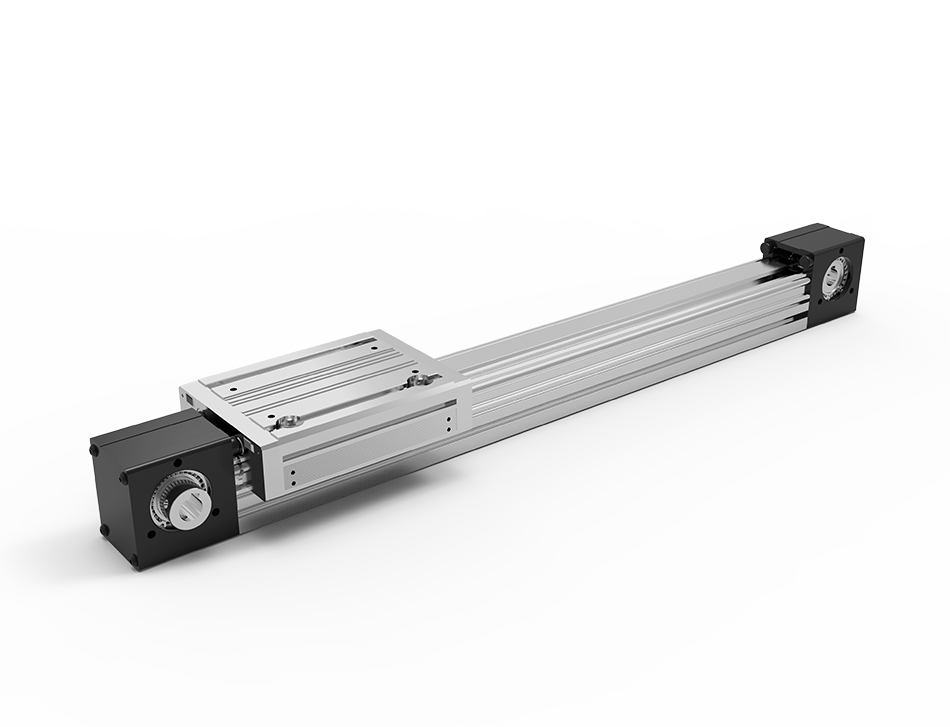
In recent years, linear motors have gained extensive attention and research in the automation industry. A linear motor directly generates linear motion without any mechanical conversion devices, converting electrical energy directly into linear mechanical energy. Thanks to their high efficiency and precision, this new drive system is gradually replacing traditional rotary motors in automated production systems and high-precision equipment.
A key advantage of linear motors is their simple and reliable structure. Direct linear motion eliminates gears, belts, ball screws and other conversion components, greatly reducing mechanical friction and backlash, and improving motion accuracy and response speed. This design also drastically cuts equipment maintenance costs and failure rates.
Secondly, linear motors deliver exceptional motion accuracy and speed. Traditional rotary motors lose precision when converting rotary to linear motion due to transmission friction and wear, while linear motors achieve micron-level (even nanometer-level) position control, making them indispensable for semiconductor manufacturing, medical devices, precision machining and other high-precision fields.
Linear motors also boast superior dynamic performance and energy efficiency. Without mechanical conversion losses, they outperform traditional rotary motors in dynamic response and energy conversion efficiency.
Despite these advantages, high manufacturing costs limit their application in price-sensitive scenarios. However, with technological progress and cost reduction, linear motors will be adopted across more industries.
In summary, with their simple structure, stability, high precision and efficiency, linear motors have replaced traditional rotary motors in high-end automated production systems. In the future, linear motors are set to become the new industry standard for automation.
The LNP series direct-drive linear motors were independently developed by TPA ROBOT in 2016. This series enables automation equipment manufacturers to integrate flexible, easy-to-install direct-drive linear motors, building high-performance, reliable, sensitive and precise motion actuator stages.
The LNP series eliminates mechanical contact and adopts direct electromagnetic drive, greatly boosting the dynamic response speed of the closed-loop control system. Free from mechanical transmission errors, and paired with linear position feedback scales (grating scales, magnetic grating scales), the LNP series achieves micron-level positioning accuracy with a repeat positioning accuracy of ±1μm.
Our LNP series has been upgraded to the 2nd Generation (NP2 Series). The NP2 series linear motor stages feature a low profile, light weight and high rigidity. They can be used as crossbeams for gantry robots to reduce the load of multi-axis robots, or integrated into high-precision motion platforms: dual XY bridge platforms, dual-drive gantry platforms, air bearing platforms, etc.
These linear motion platforms are widely applied in high-end equipment: